
High-Density Polyurethane Foam Injection in Laredo, TX
When a 100°F Laredo drought bakes the moisture out of the Lagloria silt loam beneath your property, the ground shrinks. That void left behind is exactly why your concrete driveway just dropped two inches, creating a massive, liability-inducing trip hazard right at your property line. You don't just have a concrete problem; you have a soil bearing capacity problem. Pumping heavy sand-based slurry under a sinking slab is a temporary band-aid that actually makes the underlying issue worse. To fix it permanently, you need to stabilize the soil and lift the slab with a material that won't crush an already failing subgrade.
That is where high-density polyurethane foam injection comes in. At Laredo Concrete Leveling, we bypass outdated, destructive methods and utilize advanced structural polymers to lift, level, and stabilize sinking concrete across Webb County.
Get a Precision Slab Quote
Response within 2 hours for Laredo & Webb County area residents.
The Problem with Laredo’s Soil and Heavy Concrete
Laredo’s climate is harsh, alternating between scorching droughts and sudden, heavy rainfalls. The soils here, particularly the reactive silt loams and clays found in areas like Del Mar Subdivisions and San Isidro Ranch, are notoriously unstable. When it rains, the soil absorbs water and swells. When it dries, it shrinks rapidly, leaving massive subterranean voids.
Your concrete slabs—whether it is a patio, pool deck, or driveway—are incredibly heavy. A standard 4-inch-thick concrete slab weighs roughly 50 pounds per square foot. When the soil beneath it washes out or shrinks, the slab loses its structural support. Gravity takes over, the slab cracks, and it settles into the void.
Older repair methods, like traditional mudjacking, involve pumping a heavy mixture of water, dirt, and cement under the slab to push it back up. This slurry weighs upwards of 100 pounds per cubic foot. If the original soil couldn't support the weight of the concrete, adding thousands of pounds of wet mud to the same weak subgrade is a guaranteed recipe for future failure.
Lagloria clay shrinks by up to 15% in volume during consecutive 100°F+ summer days. When monsoon storm runoffs surge through the I-35 corridor, sub-slab channels wash out within minutes, bridging unsupported 50-lb/sq.ft slabs over empty air.
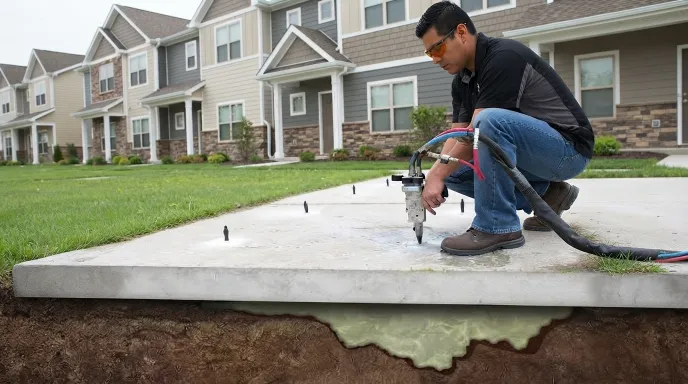
The Mechanics of Polyurethane Concrete Raising in Laredo
We approach slab settlement as a structural engineering issue. Instead of adding more dead weight to weak soil, we use polyurethane concrete raising Laredo property owners can rely on for permanent stabilization.
Our high-density closed-cell polyurethane foam weighs a fraction of what mud slurry weighs—just 2 to 4 pounds per cubic foot. Despite its extreme light weight, this engineered polymer boasts incredible compressive strength, capable of easily lifting sections of concrete that weigh thousands of pounds, while simultaneously compacting the loose soil beneath.
Here is how the chemistry and physics work when we execute foam injection concrete lifting:
We utilize a highly specialized, truck-mounted reactor that heats and pressurizes two distinct chemical components (an isocyanate and a polyol resin). These components are kept strictly separated in heated hoses right up until the point of injection. Once they meet at the tip of the injection gun and are pushed through a small port in your concrete, a rapid exothermic reaction occurs.
Within seconds, the liquid expands up to 20 times its original volume. It aggressively seeks out the path of least resistance, flowing into every microscopic void, crack, and washout channel in the subgrade. As the foam expands, it hardens into a rigid, closed-cell polymer. This expanding force provides the mechanical lift needed to precisely raise the sunken slab back to its original grade.
The Laredo Concrete Leveling Step-by-Step Injection Workflow
When you hire us for polyjacking near me, you are getting a highly controlled, precise, and permanent structural repair. We do not guess. We assess, drill, inject, and stabilize. Here is the exact field workflow our technicians execute on every job site:
1. Subgrade and Deflection Assessment
Before we drill a single hole, we map the slab. We check for existing stress fractures, measure the exact drop from the original zero-point, and assess the adjacent drainage patterns. We need to know exactly where the water is entering and washing out the soil, whether you are on a slope in Shiloh Highlands or a flat lot in Plantation.
2. Strategic Port Drilling
Traditional mudjacking requires massive, destructive 2-inch holes cored out of your concrete. It looks terrible and compromises the integrity of the slab. Our polyurethane injection process requires drilling holes that are merely 5/8 of an inch in diameter—about the size of a penny. We drill these injection ports in a calculated grid pattern across the sunken section to ensure an even distribution of the polymer.
3. High-Density Polyurethane Injection
We insert specialized mechanical ports into the drilled holes. The technician then connects the injection gun and begins pumping the heated polymer under the slab. Because the material is hydro-insensitive (hydrophobic), it will violently push out any standing water underneath the slab, filling the void with structural foam.
4. Precision Lifting
As the liquid polymer reacts and expands, the technician carefully monitors the lift. We use a combination of laser levels and specialized gauges to control the exact rate of expansion. The foam cures to 90% of its final strength in just 15 minutes, allowing us to make micro-adjustments and bring the slab perfectly flush with the adjacent concrete. We eliminate the trip hazard completely.
5. Port Removal and Patching
Once the slab is stabilized and leveled, we remove the mechanical injection ports. The 5/8-inch holes are then patched with a high-strength, non-shrink cementitious grout. We color-match the grout as closely as possible to the surrounding concrete, leaving you with a clean, functional slab that is ready for heavy vehicle traffic almost immediately.
Why High Density Polyurethane Slab Repair Dominates the Industry
If you manage a commercial property in Concord Hills or own a home in Rio Bravo, you need repairs that hold up to heavy use and harsh weather. Polyurethane foam injection offers massive technical advantages over total slab replacement and traditional mudjacking:
Hydrophobic and Waterproof
Our closed-cell foam is completely impervious to water. If a massive storm hits El Cenizo, the polyurethane will not wash out, break down, or erode. Mudjacking slurry, being primarily dirt and sand, will eventually wash away again.
Rapid Cure Times
Tearing out a driveway and pouring new concrete means you cannot park at your house for a week. Mudjacking requires days to fully cure. High-density polyurethane cures in 15 minutes. You can drive a heavy-duty pickup truck over the repaired slab before our crew even leaves your property.
Non-Invasive
The 5/8-inch holes preserve the structural integrity and aesthetics of your original concrete.
Environmental Stability
The polyurethane material we use is environmentally inert. It will not leach harmful chemicals into the Laredo groundwater supply or surrounding soil.
Permanent Soil Compaction
As the foam expands downward before lifting upward, it compresses the loose silt loam and clay subgrades, dramatically increasing the load-bearing capacity of the soil itself.
Common Applications for Foam Injection
We deploy high-density foam injection across Webb County for a variety of residential, commercial, and municipal sinking concrete issues:
- Sinking Driveways & Garage Approaches: Stopping the heavy impact and tire wear caused by dropping off a sunken lip into your garage.
- Uneven Pool Decks: Eliminating dangerous trip hazards around wet pool areas before someone gets severely injured.
- Sunken Patios & Porches: Restoring the proper slope away from your foundation to prevent water pooling against your home's exterior walls.
- Sidewalks & Walkways: Keeping neighborhood paths safe and compliant with ADA requirements.
- Interior Slab Floors: Lifting sunken concrete floors inside homes, warehouses, and commercial facilities without needing to tear off the roof or bring in heavy excavators.
Concrete does not fix itself, and the voids under your slab will only grow larger as the Texas weather continues to wreak havoc on the soil. Ignoring a dropping slab will eventually lead to catastrophic structural cracking, forcing a complete and incredibly expensive tear-out and replacement.
Stop the settlement right now. Let us stabilize the soil and lift the concrete back to where it belongs.
Call to see if your slab qualifies for foam injection.
Contact Laredo Concrete Leveling at (956) 625-9663 today for a direct technician evaluation.